
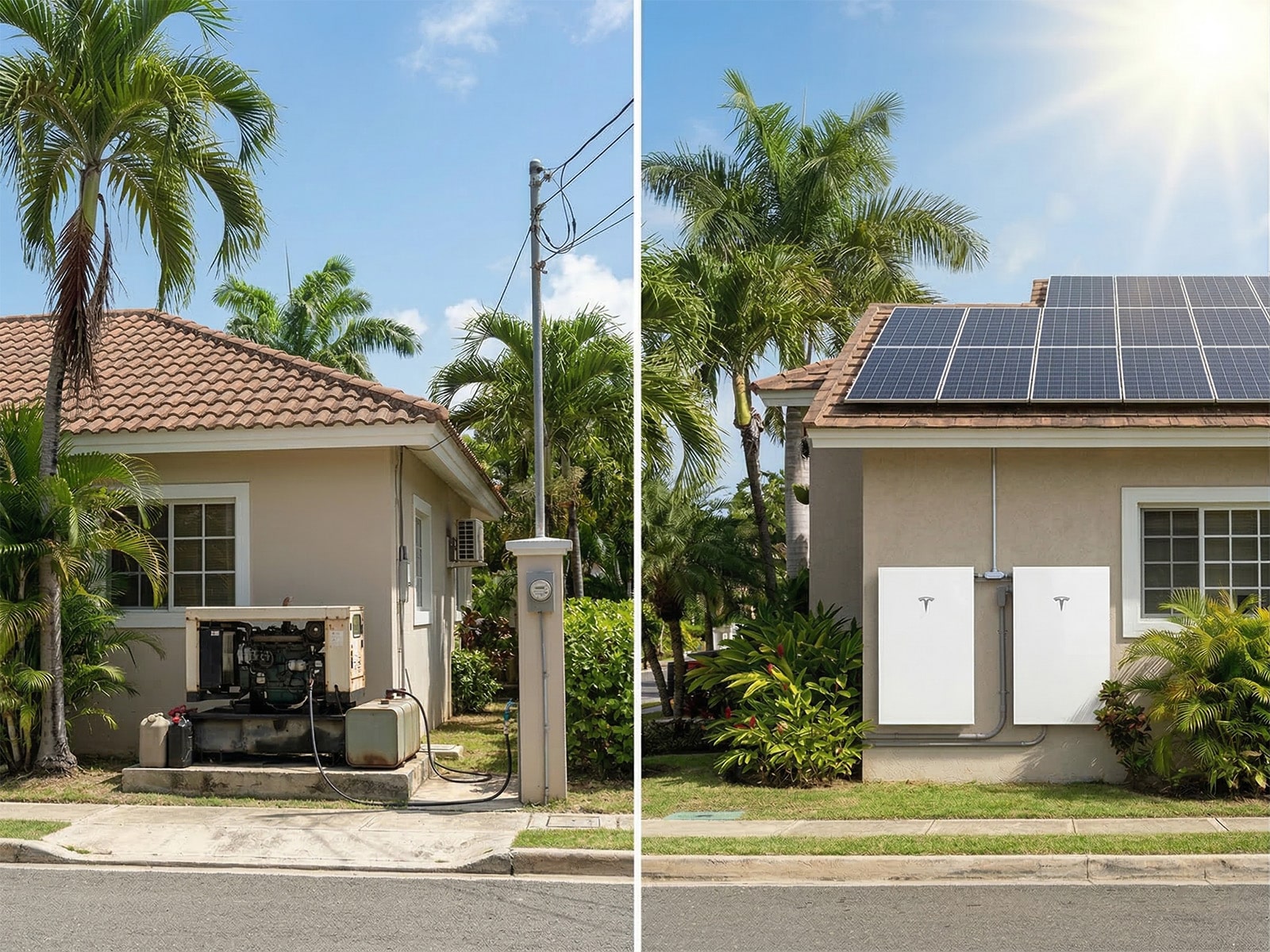
The Evolution of Energy Backup in the Dominican Republic
In the Dominican Republic, the continuity of electricity service has gone from being a luxury to a critical operational necessity. However, the paradigm is changing. At RAAS Solar , as specialist infrastructure consultants, we maintain that the transition to behind-the-meter energy storage systems is the only logical response to the volatility of generation costs and the current regulatory framework.
We are currently in a situation where the Superintendency of Electricity (SIE) is constantly adjusting the Technical Tariff for Simple Low Voltage (BTS) users , with prices ranging between RD$8.26 and RD$15.61 per kWh. Given this reality and the tightening of regulations, solid-state energy storage is not just a technological improvement; it is a strategic asset that frees the owner from the inefficiencies of traditional generation.
The Operational Reality of Combustion Generators
Traditional power plants are high-friction mechanical assets that impose a disproportionate operating load. Beyond the noise, their Achilles’ heel is their extremely low thermodynamic efficiency: a typical residential generator only converts between 20% and 30% of the fuel’s energy into electricity. The rest is wasted as heat and vibration, making them money-burning machines.
Disadvantages of Preventive Maintenance in Generators:
- Exhaustive Service Cycles: They require oil and filter changes every 50 to 100 hours of operation, an interval that in seasons of frequent blackouts may imply weekly services.
- Critical Consumables Management: Dependence on spark plugs, air filters and fuel that must be in stock to avoid starting failures.
- Diesel Degradation: Fuel stored in the country tends to degrade or become contaminated with moisture, requiring additives or constant rotation to avoid damaging injection systems.
- Prohibitive Cost: Producing energy with a plant can skyrocket to RD$50 per kWh , tripling the cost of the grid and eliminating any notion of energy savings.
Tesla Powerwall 3: The Promise of “Zero Maintenance”
In contrast to the complexity of a combustion engine, the Tesla Powerwall 3 stands out as a solid-state system with no moving parts. By eliminating pistons, belts, and lubrication systems, the risk of mechanical failures and the need for frequent technical visits are eliminated. Its sealed liquid-cooling design autonomously manages the temperature, protecting the cells even in our island’s tropical climate.
User maintenance is minimal and guarantees the longevity of the equipment:
- Housing Cleaning: Use a soft, lint-free cloth, moistened only with water and mild soap.
- Waste Management: Keep air intake and exhaust grilles free of debris (leaves, trash or dust).
- RAAS Solar Pro Tip: According to the Tesla manual, the air intake grille can be removed and cleaned with a hose if excessive dust buildup is observed, always ensuring that the unit is dry before replacing it.
- Prohibitions: Never use solvents, harsh chemicals, or flammable vapors near the unit.
Intelligent Connectivity and Over-the-Air (OTA) Updates
The Powerwall 3 is a digital asset that evolves while you sleep. Through its comprehensive connectivity—dual-band Wi-Fi, Ethernet, and LTE/4G cellular backup—the system receives over-the-air software updates that optimize charging algorithms and extend cell life without human intervention.
This update process is divided into two phases:
- Download Phase: The system detects and downloads the new firmware in the background without interrupting the home’s power supply.
- Installation Phase: A period typically lasting 15 to 30 minutes during which the system applies the upgrades. These updates not only correct errors but also adapt the equipment to new changes in the grid infrastructure or photovoltaic integrations at the distribution companies.
Silence is Tranquility: Compliance with Law No. 90-19
Noise pollution is the cause of 95% of environmental complaints in the country. Under Law No. 90-19 , authorities (via 911) have the power to confiscate equipment and impose fines of 10 to 30 minimum wages on those who exceed permitted limits. While a generator emits between 75 and 90 dB(A), the Powerwall 3 operates with absolute discretion.
Legal Compliance: Area II (Residential Zone)
| Time Period | Limit Law 90-19 | Powerwall 3 Emission | Legal Status |
| Daytime (07:00 – 21:00) | 60 dB(A) | < 50 dB(A) | COMPLIES |
| Nighttime (9:00 PM – 7:00 AM) | 50 dB(A) | < 50 dB(A) | COMPLIES |
The Powerwall 3 is the only solution that guarantees total immunity to neighborhood complaints, usually operating below the noise threshold of a normal conversation, even at maximum power.
Efficiency and Total Cost of Ownership (TCO) Analysis
The investment in Powerwall 3 is justified by its ability to transform resilience into savings. While the cost of diesel fuel is a sunk cost, solar storage is an investment with a rapid return.
A key factor for the Dominican market is its 185 LRA (Locked Rotor Amps) starting capacity . This allows central air conditioners and water pumps to be powered without the annoying flickering (voltage drop) in the lights and without the need to install oversized generators that consume more fuel than necessary.
The 3 Pillars of ROI in the Dominican Republic:
- Zero Marginal Cost: Integrated with solar panels , the cost per kWh is RD$0, avoiding the expensive blocks of the BTS grid tariff.
- Tax Incentive Law 57-07: Owners can benefit from a 40% tax credit on the cost of the equipment , deductible from Income Tax (ISR) over a period of three years.
- Extreme Environmental Resistance: Its IP67 rating guarantees that the equipment is completely dustproof and resistant to temporary immersion in water, a vital specification in the face of urban flooding and tropical climates.
Technical Specifications at a Glance
| Parameter | Technical Specification |
| Total Battery Energy | 14 kWh |
| Usable Energy | 13.5 kWh |
| Continuous Power (On-Grid) | 11.5 kW |
| Load Starting Capacity | 185 LRA |
| Round-Trip Efficiency (Solar/Battery) | 89% |
| Environmental Resistance | IP67 (Electronics) / NEMA 3R |
| Limited Warranty | 10 years |
An Invisible and Worry-Free Electric Future
For us at RAAS Solar , true peace of mind isn’t just about having energy, but about forgetting how it’s produced. The transition from a combustion generator to the Tesla Powerwall 3 represents the end of an era of grease, noise, and unpredictable fuel bills.
Choosing solid-state storage means choosing invisible resilience that complies with the law, takes advantage of the tax incentives of Law 57-07, and remains current through digital updates. It is, ultimately, the smartest investment for the Dominican homeowner seeking true energy independence and complete peace of mind.
