
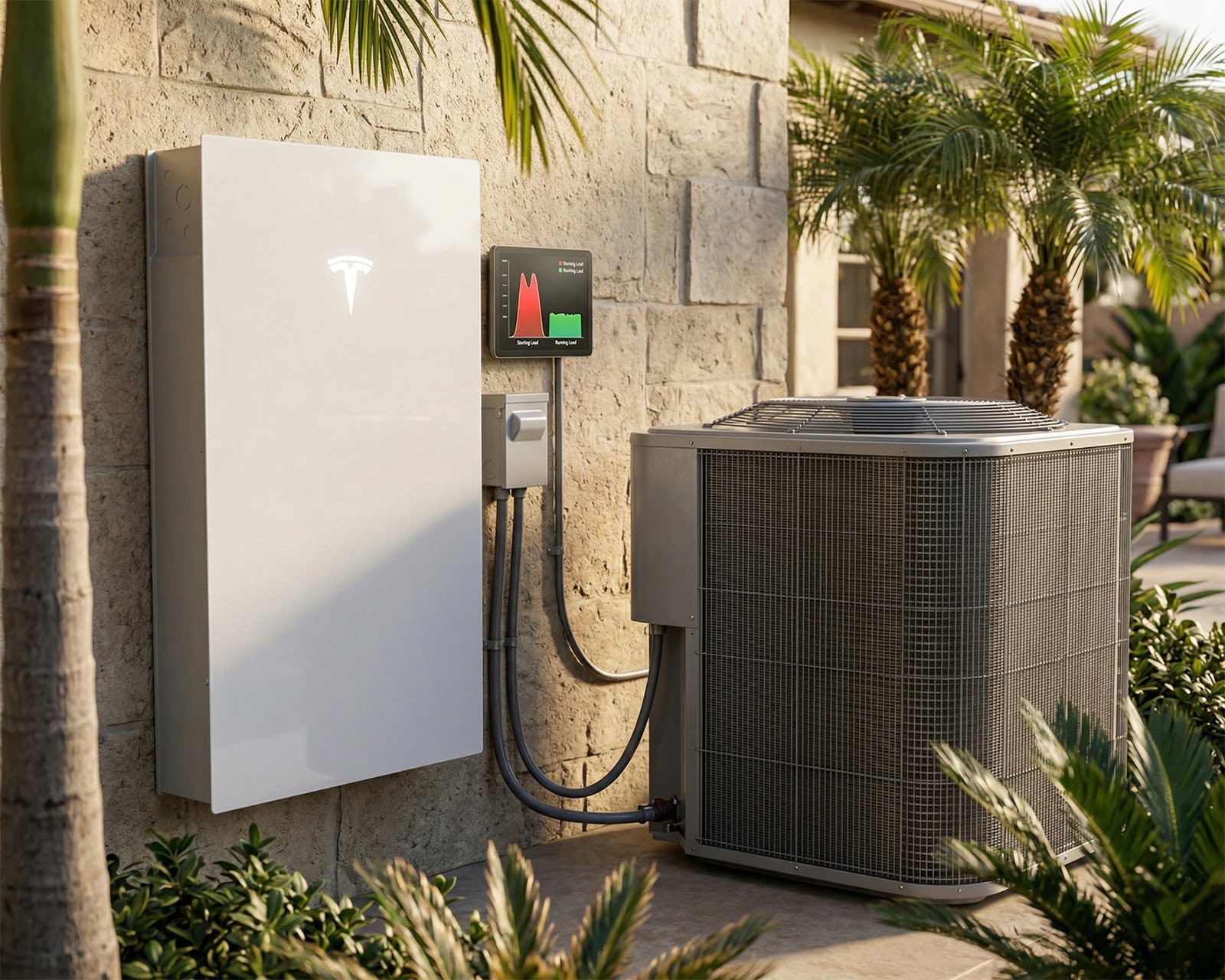
The Challenge of Thermal Comfort in the Caribbean
At RAAS Solar, we have set ourselves the mission of transforming the energy vulnerability of Dominican homes into absolute resilience. In our tropical climate, air conditioning is not an option, but a fundamental pillar of quality of life. However, homeowners with 5-ton central air conditioning units have historically faced a technical obstacle: the inability of conventional energy storage systems to handle the surge in power that these units demand.
We understand that a backup system that fails just as the compressor tries to start doesn’t live up to its promise. That’s why we see the Tesla Powerwall 3 not just as a battery, but as the engineering necessary to guarantee uninterrupted comfort. Designed for the 120/240V, 60Hz split-phase power grids typical of the Dominican Republic, this system represents the definitive and optimistic solution for achieving true energy independence.
LFP Chemistry: The Technological Heart of Powerwall 3
The Powerwall 3’s evolution to Lithium Iron Phosphate (LFP) chemistry is an engineering milestone that prioritizes safety and efficiency in demanding environments like ours. Unlike previous NMC chemistries, the LFP architecture and DC-coupled design enable a round-trip efficiency of 89% (Solar-Battery-Home), minimizing energy losses.
- High Thermal Safety: LFP cells have a much higher chemical stability threshold, which drastically reduces the risk of thermal runaway. This is vital in Dominican installations where ambient temperatures often exceed 35°C.
- Longevity and Lifecycles: The Powerwall 3 is designed to withstand daily deep charge and discharge cycles for decades. Tesla backs this durability with a 10-year warranty, ensuring the system maintains its performance even under heavy use.
- Sustainability and Ethics: By eliminating cobalt from its composition, the Powerwall 3 is not only safer, but also more environmentally responsible, reducing dependence on materials with conflicting supply chains.
The Science of Starting: Understanding LRA and the 5-Ton Challenge
To properly size a backup system, engineers focus on Locked Rotor Amps (LRA) . While a 5-ton air conditioner consumes between 3.5 and 4 kW during steady-state operation, the exact moment the compressor starts generates a massive inrush current.
In 5-ton equipment, this peak can range between 100 and 150 Amps , an “electrical violence” that triggers the internal protections of most residential batteries, causing an instant blackout of the backup power.
“LRA defines a system’s ability to overcome engine inertia. With a starting capacity of 185 LRA, the Powerwall 3 eliminates the need to oversize the battery bank just to power the air conditioning, handling peak loads that were previously unattainable for a single unit.”
Power Specifications: Powerwall 3 vs. Actual Consumption
The Powerwall 3 is optimized for the Dominican electrical grid, operating natively at 240V AC (Split-phase) without the need for additional transformers.
| Specification | Powerwall 3 Capacity | Impact on Air Conditioning (5 Ton) |
| Continuous Power | 11.5 kW (@240V AC) | It supports the operating consumption (3.5-4 kW) leaving room for other appliances. |
| Starting Capacity | 185 LRA | It easily exceeds the 100-150A inrush current needed to start the compressor. |
| Usable Energy | 13.5 kWh | It provides extended autonomy, optimized by its 89% efficiency. |
Optimization Strategies I: Soft Starters
Despite the robustness of the Powerwall 3, at RAAS Solar we recommend integrating a soft starter . This electronic device smooths the compressor’s acceleration ramp, significantly reducing the initial current spike. By implementing a soft starter, we not only decrease the stress on the Powerwall’s inverter, but we also extend the lifespan of the air conditioning equipment by reducing the mechanical impact on the motor, achieving perfect harmony between energy storage and consumption.
Optimization Strategies II: Load Intelligence with TACO and Load Shedding
The Tesla Asset Controller (TACO) enables intelligent management through the Load Shedding function . We configured this logic to prioritize energy when the system operates off-grid.
- Relay Configuration: We use the “Aux” terminals of the Powerwall 3, which act as a dry contact limited to 60V and 2A.
- Control Logic: The relay is configured as “Normally Open” (NO). Under normal network conditions, the circuit remains closed, allowing the thermostat to control the air.
- Automatic Management: If a power outage occurs and the battery level is critical, the TACO opens the thermostat circuit. This safely shuts down the compressor, preserving power for vital loads such as lighting, food refrigeration, and communication systems.
Maintenance and Durability in Demanding Environments
The Powerwall 3 design has evolved to withstand the high humidity and salinity conditions of our region. Unlike previous models, the Powerwall 3 uses a fan-assisted aluminum heat sink instead of liquid cooling. For a consulting engineer, this is a competitive advantage: it eliminates potential leaks and simplifies maintenance in tropical climates.
- Airflow Cleaning: It is essential to keep the air intake and exhaust areas clear so that the aluminum heatsink operates at maximum efficiency.
- Ingress Protection (IP): The system has IP67 certification for the battery and electronics (protection against temporary immersion), while the wiring compartment has an IP55 rating , guaranteeing safety against rain and dust.
- Installation Accuracy: Expert configuration of current transformers (CTs) is essential for the system to accurately read the energy flow and avoid backup errors.
- Strategic Location: Although it is suitable for outdoor use, it is recommended to avoid direct and prolonged exposure to the sun to prevent degrading the power due to high temperature (derating from 40°C).
Towards a Self-Sufficient Dominican Republic
The Tesla Powerwall 3 technology, combined with RAAS Solar’s technical precision, allows us to confidently say that the fear of power outages is a thing of the past. By installing a system capable of handling 185 LRA startups and harvesting solar energy with 89% efficiency, we’re not just protecting a home; we’re enabling a lifestyle where our island’s sun becomes the engine of our comfort. True energy freedom lies in enjoying the Caribbean climate knowing that your system not only withstands the environment but harnesses it for your benefit and peace of mind.
