
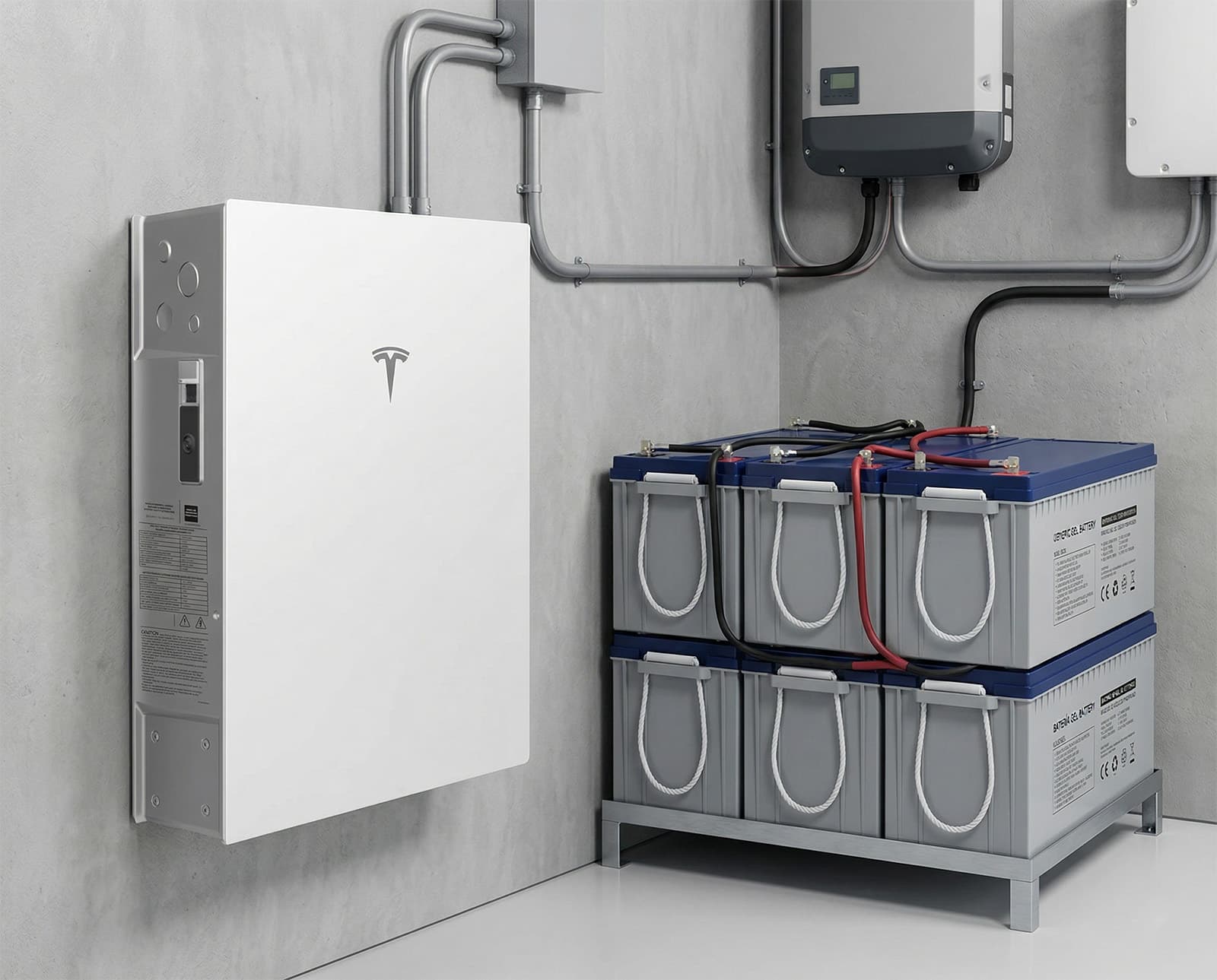
At RAAS Solar , we have established ourselves as the leading engineering and consulting firm for energy storage solutions in the Dominican Republic. Our mission goes beyond simple installation; we seek to empower Dominican families by transitioning them to technologies that ensure resilience against power outages and instability in the national grid.
This technical report analyzes the critical differences between traditional gel (lead-acid) battery technology and the new Tesla Powerwall 3. As specialists, our experience in the field has shown us that the choice of energy storage not only affects the availability of electricity during a downpour or storm, but also long-term profitability and asset security.
Technological Comparison: Composition and Efficiency
The Powerwall 3 represents a paradigm shift by integrating a hybrid inverter capable of managing up to 20 kW DC of solar power. Its Lithium Ferrophosphate (LFP) chemistry offers superior thermal stability compared to gel batteries. While lead-acid batteries can suffer from chemical fatigue, LFP has a significantly higher thermal runaway threshold, making it virtually impossible to overheat—a vital safety factor for residential installations in our tropical climate.
| Feature | Tesla Powerwall 3 | Gel Batteries (Lead-Acid) |
| Round-trip efficiency | 89% (Solar to Battery to Home) | ~70% – 80% (High heat losses) |
| Investor Efficiency | 97.5% (Solar to Grid/Home) | Requires external investor (Extra losses) |
| Chemical Composition | Lithium Iron Phosphate (LFP) | Sealed Lead Acid (Gel) |
| Dimensions | 1105 x 609 x 193 mm | Bulky (Require racks/shelves) |
| Weight | 130 kg (High density) | >400 kg (To equalize usable capacity) |
| Warranty | 10 years (Unlimited Cycles) | 1-2 years (Limited by cycles) |
| Scalability | Up to 4 units (54 kWh total) | Limited by resistance imbalance |
Depth of Discharge (DoD) and Energy Utilization
The Depth of Discharge (DoD) defines how much energy we can extract without compromising the battery’s integrity. This is where the numbers often confuse the user: a gel battery should not be discharged beyond 50% if it is to last for a few years.
“In operational terms, this means that to obtain the 13.5 kWh of usable energy offered by a single Powerwall 3, you would need a gel battery bank with a nominal capacity of 27 kWh. The Powerwall 3 allows for the safe and consistent utilization of 100% of its nominal capacity.”
Life Cycles and Longevity: The Reality of Investment
Durability is the defining factor of Return on Investment (ROI). In the Dominican Republic, extreme heat is the number one enemy of batteries.
- Gel Batteries: Their lifespan of 4 to 8 years is halved if operated in environments above 30°C without constant air conditioning. This means that, during the lifespan of a Powerwall 3, a customer would have to replace their gel battery bank at least two or three times, doubling or tripling their initial cost.
- Tesla Powerwall 3: Designed for a 10- to 15-year operating life. Tesla backs the equipment with an unlimited cycle warranty and ensures 70% capacity retention after a decade, regardless of how many times it is discharged during daily power outages.
Power Output and Critical Load Management
One of the biggest challenges for backup power systems in the country is the startup of air conditioners . These units generate an initial current surge (inrush current) that often causes voltage drops in gel banks, tripping the protective circuit breakers.
The Powerwall 3 has a starting capacity of 185 LRA (Locked Rotor Amps) . This allows it to start and maintain air conditioners up to 5 tons without problems . Thanks to its high surge capacity, the system handles these loads without needing grid support, ensuring that your home’s comfort is not interrupted by a power outage.
Maintenance and Environmental Resistance (Corrosion)
The maintenance experience is radically different between the two technologies:
- Gel batteries: These require constant monitoring of the terminals to prevent corrosion and rust. They are usually open systems or racks that attract dust and moisture, which accelerates their degradation in high-salinity areas.
- Tesla Powerwall 3: It’s a “set it and forget it” system. It requires no scheduled preventative maintenance. Its chassis has an IP67 protection rating for the electronics and battery, and a NEMA 3R enclosure . This makes it ideal for coastal areas like Punta Cana, Samaná, or Juan Dolio, where sea breezes often damage the components of traditional inverters.
Intelligent Management and Software:
- Storm Watch: This feature automatically monitors for tropical storm or trough alerts across the country. Upon detecting an alert, the system prioritizes load to 100% to ensure maximum reserve capacity before transmission lines fail.
- Thermal Management: Through its forced ventilation and automatic heating mode, it keeps the cells in the optimal range, something that gel systems, which depend on ambient temperature, cannot emulate.
The Choice of RAAS Solar
From RAAS Solar ‘s technical and economic perspective , the conclusion is clear: the Tesla Powerwall 3 is the definitive solution for the Dominican market. Although the initial investment exceeds that of a gel bank, its 89% efficiency, 185 LRA starting capacity, and corrosion resistance in coastal environments make it the most robust and cost-effective option.
The Powerwall 3 doesn’t just store energy; it manages your home’s future with intelligence and security.
